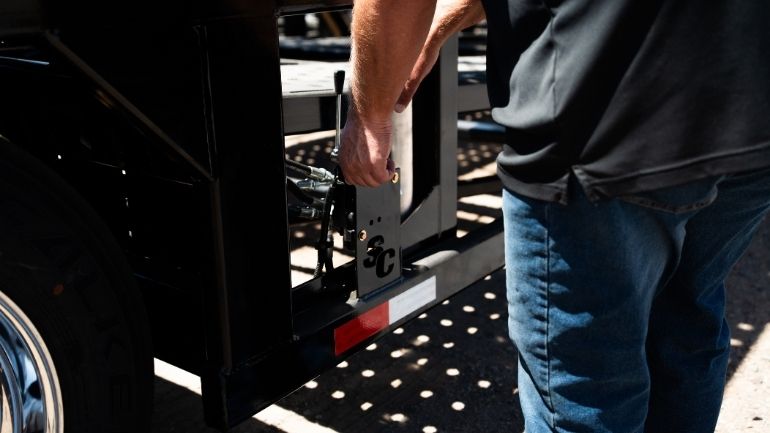
Your trailer doesn't take days off, so your maintenance routine shouldn’t either.
For owner-operators running a commercial car hauler business, your trailer isn't just another piece of support equipment; it's the primary revenue-generating asset in the business. When it's rolling and loaded, it's making money. When it's sidelined for an avoidable repair, it isn't. The math on preventive maintenance is brutally simple: a few hours of systematic inspection every 90 days costs a fraction of what an unplanned breakdown costs in parts, labor, towing, and lost loads.
Sun Country Trailer builds 3-, 4-, and 5-car haulers for operators all over the nation, and while we are justifiably proud to say our products are strong and well-built, the reality is that every mechanical device in the world will suffer from wear and tear; it’s simply the nature of material things, and that is especially true when you are talking about trailers. Cars are loaded and unloaded every day, using the ramps, hydraulics, and tie-downs. Trailers travel thousands of miles over highways, gritty side roads, and up and down mountain roads, over potholes and railroad tracks, in wind, rain, snow, and beating sun. Few things can withstand that kind of a beating without needing some extra care now and then.
So, in addition to doing basic checks and walk-arounds before each trip, below is a more thorough and practical 90-day inspection checklist built around the systems that matter most on a commercial car hauler. Always refer to your trailer's specific operation manual and component manufacturer documentation for the authoritative service intervals and procedures for your unit; this checklist is a working framework, not a substitute for manufacturer guidance.
Before You Start: Pull Your Paperwork
Before you get under the trailer, take five minutes with your records. Note the date of your last service on each major system, your current mileage, and any issues you've been meaning to look at. Maintenance done without documentation is maintenance that can't be tracked — and on a commercial unit, trackable service history is also a resale asset. So keep your paperwork up-to-date and check it.
Purchasers of Sun Country trailers are provided with an operation manual at pickup which contains the authoritative maintenance schedule and lube point specifications for your unit. If you don't have it, contact Sun Country's Parts & Service department; we can help.
1. Frame and Structural Inspection
Start with a visual walk of the entire frame. You're inspecting for anything that wasn't there last time. Look for cracks or fractures at weld points and high-stress joints; deformation or bending in frame members, crossmembers, or ramp supports; loose, missing, or damaged bolts and fasteners throughout the structure; and any signs of corrosion breaking through the finish, particularly at joints, seams, and areas where road debris has caused surface damage.
Pay particular attention to the ramp hinges and pivot points. These see high cyclic stress from repeated loading and unloading and are among the first places fatigue will show up on any hauler.
On a Sun Country trailer, the heavy-gauge steel construction and proper surface preparation with shot blasting and zinc-rich primer under the powder coat gives the frame a meaningful head start against corrosion, but no finish is invulnerable to physical damage from road debris, and any chip or breach in the coating should be addressed before moisture gets into the steel beneath it.
Touch up any compromised finish areas promptly. Left alone, even a small breach in the finish system has the potential to become a rust initiation site.
2. Hydraulic System
The hydraulic system is the operational heart of a multi-car hauler. Cylinders that move slowly, unevenly, or not at all don't just create inconvenience; they create dangerous loading conditions.
At each 90-day interval, check the hydraulic fluid level and condition. Sun Country Trailers generally specifies 32-weight hydraulic fluid, and recommends changing the filter and fluid every 6 to 12 months depending on the operating environment. If you're in a dusty environment or running hard miles in heat, opt for the shorter interval.
Inspect all hydraulic lines, fittings, and connections for leaks, abrasion, or chafing against frame members. A line that's rubbing on steel will eventually wear through; find it before it fails under pressure. Cycle each cylinder through its full range of motion and watch for hesitation, drift, uneven movement, or unusual sounds. Check that all hydraulic controls (including any wireless remote system) are functioning correctly and responding as expected.
If you have a Pierce wireless remote system, verify the battery condition in the transmitter and confirm the receiver is securely mounted and showing no signs of corrosion at the connections.
Any cylinder that is seeping, drifting under load, or moving unevenly warrants a rebuild or replacement before it becomes a field failure. Sun Country's service department handles cylinder rebuilds and hydraulic system diagnostics in-house — a faster path to resolution than sourcing a third-party shop unfamiliar with the system.
3. Running Gear: Brakes, Axles, and Suspension
This is the section where skipping the checklist has the most immediate safety consequences. Brake system integrity should never be a deferred maintenance item.
Whether your trailer runs electric brakes or air brakes, inspect the brake components for wear, adjustment, and function at every 90-day interval. On electric brake systems, check the magnet and drum condition, verify the brake controller is functioning correctly, and confirm proper adjustment. On air brake systems (equipped on Sun Country's air brake configurations with Bendix disc brake axles) inspect the chambers, lines, and slack adjusters, and confirm there are no air leaks anywhere in the system. Listen for any hiss at connections when the system is charged.
Sun Country trailers use Dexter and Ridewell axle assemblies depending on configuration. Grease-packed hub bearings should be serviced every 12,000 miles or once per year, whichever comes first. Oil bath hubs require less frequent intervention but should have their oil level checked at every pre-trip inspection — confirm the oil is at the fill line. At the 90-day mark, even if you haven't hit 12,000 miles, inspect the hub seals for any sign of weeping or leakage, check for play in the bearings, and look for heat discoloration on the hub that might indicate a developing problem.
On trailers equipped with Ridewell suspension assemblies, inspect the air bags (if applicable), hangers, torque rods, and bushings for wear, cracking, or looseness. Consult the Ridewell RA240 or RA266 owner's manual for the specific service intervals and procedures for your suspension configuration.
If your trailer is equipped with ABS, verify that the system indicator is functioning correctly when connected to your truck. Any persistent fault codes should be diagnosed before the next haul.
4. Tires and Wheels
Tires are a known consumable, but they're also a safety-critical one. A commercial hauler running loaded at highway speeds on compromised tires is a serious liability.
Inspect each tire for: tread depth and wear pattern uniformity; sidewall cracking, bubbling, or impact damage; valve stem condition; and correct inflation pressure per the load rating. Sun Country trailers generally use Hankook, Falken, Michelin, and Yokohama tires depending on configuration, and the specific inflation specifications are available in your trailer tire documentation.
Uneven wear patterns tell a story: cupping suggests a suspension or balance issue, one-sided wear suggests alignment, center-strip wear suggests chronic overinflation. Don't just replace or rotate worn tires; understand why they wore the way they did to identify if there are other trailer or load issues you need to pay attention to.
Inspect the Accuride wheels for cracks, particularly around the lug holes and valve stem cutout, and verify that all lug nuts are present and at the correct torque specification. Wheel fasteners can work loose under vibration, and a loose wheel on a loaded hauler is a potential problem waiting to happen.
5. Electrical Systems
Lighting and electrical connections are among the most commonly neglected items on a commercial trailer, but also among the most frequently cited in roadside inspections.
It’s important to walk every light on the trailer: tail lights, brake lights, turn signals, marker lights, and clearance lights. Replace any burned bulb immediately; traveling with non-functional lights is both a citation risk and a safety issue. Inspect the main harness connector for bent or corroded pins, and check the wiring along the frame for any chafing, bare spots, or loose mounting that could cause a short or intermittent fault.
If your trailer has a wiring issue that isn't obviously due to a bulb or connector, the wiring diagrams for Sun Country trailers are available and can help a qualified technician trace the problem efficiently.
6. Floors, Tie-Downs, and Deck Hardware
The deck is where cargo security lives. Inspect every tie-down point in the pouched floor for deformation, cracking around the punch, or any sign of elongation that would compromise the strap anchor. A tie-down point that has been overloaded or improperly used can fail in ways that aren't obvious visually; if anything looks off, have it assessed before relying on it with a load.
Check all ratchet straps and soft straps in your kit for webbing wear, fraying, damaged hooks, and ratchet mechanism function. Straps are consumables; a worn strap costs very little to replace but will cost you an enormous amount in dollars, damage, and potential injury to others if it fails on the road.
Inspect the deck flooring surface itself for sections that have lifted, cracked, or worn through. Compromised flooring reduces traction during loading and can become a trip hazard during tie-down operations.
7. Lubrication of Moving Parts
Apply graphite lubricant to all moving parts — posts, ramps, and similar components — on a regular basis. At the 90-day mark, work through every moving point on the trailer systematically. Ramp hinges, slider mechanisms, post fittings, and any other pivot or sliding interface should be clean, free of grit and debris, and freshly lubricated.
Neglected moving parts don't just wear faster; they make the trailer harder to operate and put more stress on the hydraulic system that has to move them.
8. Fifth Wheel and Hitch Connection Points
If your trailer connects via a fifth wheel configuration, inspect the kingpin for wear and the coupler for proper latching and security. Check the safety chains for condition and proper attachment hardware. Verify the breakaway system (if your trailer is equipped with one) is functional and that the battery or charge source is in good condition.
When the Checklist Finds Something
A checklist is only useful if findings lead to action. For issues beyond your own capability to address, such as hydraulic cylinder problems, brake system repairs, structural welding, or axle service, contact Sun Country's Parts & Service department. In some cases, we even offer same-day service, and we always offer competitive labor rates and more than 40 years of experience working specifically on commercial car haulers.
We will work on any trailer, not just Sun Country units, and have the in-house fabrication capability to address problems that a general repair shop may not be equipped to handle.
For parts, contact our Sun Country service department at (602) 268-6406. For major service needs, calling as soon as possible to set up an appointment ensures the fastest possible turnaround.
The Bottom Line on 90-Day Maintenance
A commercial car hauler is a machine that earns its keep through reliability. The operators who get the most out of their equipment and the most out of their investment are those who treat their trailers well by making sure maintenance is a scheduled business activity, not a reaction to problems.
Ninety days goes by faster than you think. Put and keep your inspections on the calendar and stick to the schedule. Preventive maintenance will always save you time, money, and trouble far beyond the momentary inconvenience of interrupting service, so build it into how you operate.
Questions about parts, service intervals, or what your specific Sun Country trailer needs? Call our team at 866-887-2453 or visit our website. We’ll do everything we can to keep you on the road.