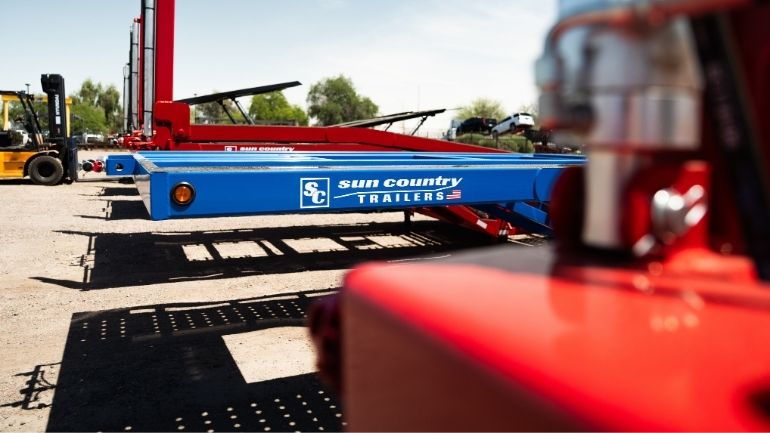
Buying a commercial car hauler is not a casual purchase. For an owner-operator, it may be the single largest investment in the business. For a small fleet adding a unit, it's a decision that will affect capacity, driver efficiency, and maintenance overhead for years to come. Getting it right the first time matters.
The challenge is that car haulers, on the surface, may look deceptively similar. Walk a dealer lot or scroll a manufacturer's website and the category can feel like a sea of steel and hydraulics where meaningful differences are hard to identify. Don't be fooled: they are not. The specs that actually separate a trailer that builds your business from one that costs more than it earns are discoverable, but only if you know what to look for.
The reason Sun Country Trailers takes pride in being one of the top recommended car trailer manufacturers in the US is that our recommendations come from real hauling operators. When you drill down to what matters when the rubber literally hits the road, you quickly learn that there are some things you should not compromise on. So, if you want some insight into how you should make your decision, here are five specifications that experienced operators and small fleet buyers should compare carefully before signing anything.
Spec #1: Frame Construction
Everything else on a car hauler sits on top of the frame, which means the quality and design of the frame — how it's built, what it's built from, and how well it holds up under the daily punishment of commercial hauling — determines the long-term performance of every other system on the trailer.
The question to ask any manufacturer is direct: what is the steel specification, and how is the frame fabricated? Vague answers such as "heavy-duty steel" without any further context or information about how it's fabricated or finished deserve follow-up. Specific answers that describe the manufacturing process, the material grade, and the quality controls in place tell you something meaningful.
Sun Country Trailers builds its commercial haulers with heavy-gauge steel throughout, hand-fabricated by skilled workers in their Phoenix, Arizona, facility. Parts are precision-cut on a tube laser and CNC plasma cutting table before any fabrication begins, which means components fit together correctly before the first weld is laid. The result is tighter tolerances, cleaner joints, and a more structurally sound trailer than one assembled from imprecisely cut parts. Add in a detailed quality control protocol that checks construction integrity multiple times throughout the manufacturing and assembly process, and you get a trailer you can rely on that’s built to last.
This isn't visible on the showroom floor. It shows up over years of use — in whether the frame holds its geometry, whether welds develop fatigue cracks at high-stress joints, and whether the trailer performs as well in year six as it did in year one.
Questions to ask:
- How is the frame fabricated?
- Is it hand-built or mass-produced?
- What quality controls govern the fabrication process?
Spec #2: Trailer Configurations that Match Your Hauling Rig and What You Haul
Sun Country has a full lineup of 3-, 4-, and 5-car trailer configurations. What's best for you primarily depends on two elements: what truck are you towing with and what vehicles are you hauling?
If towing with a dually pickup or cab-chassis, our electric brake line has several options to choose from. Each comes with the highest grade suspension system in its class for optimized braking, improved safety, and to minimize overall maintenance costs.
If you are starting up in the hauling business, we offer a traditional 53' Wedge trailer and a 3-car Drop Deck trailer. Specifically for Cab-Chassis towing, we offer a 3- and 4-car Lo Pro design for easy loading with the Sun Country durability we're known for at the right price. To maximize loading configurations, our 5-car Drop Deck offers the highest capacity in the electric brake family to provide you the most flexibility in hauling a mixture of vehicle types.
The right trailer spec starts with the right match to your truck.
Questions to ask:
- What tow vehicle is this configuration designed for?
- What vehicles are you primarily hauling?
- What are your typical route distances?
Spec #3: Load Versatility and Vehicle Profile Compatibility
Car count is how buyers often compare trailers. Load versatility is how experienced operators actually think about capacity.
A 5-car hauler that can only load average-length sedans efficiently isn't the same business asset as a 5-car hauler that can handle a mixed load of sedans, pickups, and vans. The latter fills more loads, serves more customers, and turns down fewer jobs. The former looks equivalent on a spec sheet but underperforms in the yard.
The key variables affecting load versatility are deck configuration flexibility, slot length, loading geometry, and the range of vehicle heights the trailer can accommodate. Sun Country's Next Generation 5-Car Hauler is specifically described as giving operators the optimal range of load configurations for pickup trucks of any quick loader on the market, but is also designed for a mix of sedans, SUVs, and vans. The Anniversary Edition variant of the same platform features an angled curve to the front deck and frame specifically to improve compatibility with minivans, SUVs, and other high-profile passenger vehicles, offering the most flexibility of our 5-car offerings.
For operators whose business skews heavily toward large vehicles — trucks, full-size vans, high-profile SUVs — Sun Country's air ride, air brake configurations were built for exactly that application. The 53-foot Air Ride, Air Brake haulers include a dump valve on the air ride suspension to lower the trailer during loading and unloading, which meaningfully improves the loading experience for tall vehicles. That's the kind of practical engineering detail that doesn't show up in a simple car count comparison but makes a real difference on every load.
Sun Country also offers the highest ground clearance in the industry across its lineup — protecting the trailer on rough roads, railroad crossings, construction zones, and uneven surfaces that are simply unavoidable in commercial hauling.
Questions to ask:
- What vehicle types is this configuration optimized for?
- What is the range of vehicle heights it can accommodate?
- How does the loading geometry change with different load mixes?
Spec #4: Surface Finish and Corrosion Protection
This is the specification that most buyers skip — and one of the clearest indicators of how seriously a manufacturer takes the long-term performance of their product.
Steel and moisture are natural adversaries. A trailer without a robust corrosion protection system will rust from the inside out over time, weakening structural members and shortening service life in ways that aren't always visible until significant damage has already occurred. The finish system isn't cosmetic; it's structural protection.
Car haulers don’t just have to withstand the elements outdoors like a piece of lawn furniture. They have to withstand the elements outdoors hour after hour, traveling mile after mile over road grit, potholes, dirt, gravel, and railroad tracks. Accordingly, the meaningful question isn't just "what finish does it have?" It's "what preparation did the steel receive before the finish went on?" A quality finish applied to improperly prepared steel bonds poorly and fails faster than it should.
Sun Country has recently upgraded its pre-treatment system and uses a steel shot blast system on all its trailers before any undercoat and finish are applied. Shot blasting removes mill scale, surface oxidation, and contaminants that would otherwise weaken the bond between steel and coating, and creates a consistent surface profile that gives the finish significantly more mechanical adhesion. The finish system is then a zinc-rich primer as a base layer, providing electrochemical protection against rust even if the topcoat is later chipped or scratched, followed by a high-quality powder-coat outer layer.
The practical result is a trailer that holds its appearance and resists corrosion measurably better than one finished with a simpler single-stage process. It's one of the reasons Sun Country trailers carry the highest resale value in the market. The finish system contributes directly to how well the trailer ages.
Questions to ask:
- What surface preparation is performed before the finish is applied?
- Is there a primer layer?
- What is the finish system, and what is it designed to protect against?
Spec #5: Manufacturer Support: Warranty, Service, and Parts
A trailer specification isn't just what the unit does when it's new. It's what the relationship with the manufacturer looks like over the years of ownership. This is the spec that never appears on a comparison sheet and is frequently the most consequential one when assessing the total cost of ownership.
Three questions define this spec:
- What does the warranty actually cover?
- Who handles service and repairs?
- How long has the manufacturer been doing this?
Sun Country Trailers backs every new unit with a full one-year warranty covering the structure, with vendor warranties covering pre-assembled components. More significantly, Sun Country operates an in-house Parts & Service department at our Phoenix facility that handles the full range of commercial hauler service needs: hydraulic cylinder rebuilds and replacements; running gear diagnostics and repair including brakes; ABS and air lines; equipment additions; fifth wheel hitch installation; and fabrication of custom parts via their tube laser and CNC plasma cutting table.
Our service team has more than 40 years of hands-on experience, will work on any trailer regardless of manufacturer, employs experienced welders, and offers possible same-day service with competitive labor rates.
That infrastructure matters differently depending on where you are in your business. For a new owner-operator buying a first trailer, it's a safety net. For a small fleet operator managing multiple units, it's an operational resource, providing owners with a reliable service team that knows the equipment from the inside out and can turn units around fast.
Sun Country also works with multiple lenders to provide financing on new trailers, streamlining the process without requiring buyers to navigate multiple banks independently. For an owner-operator making a major capital investment, that kind of support on the front end of the purchase reflects the same customer-first approach that distinguishes our service relationship on the back end.
Putting It Together: Matching the Spec to the Operation
No single specification can answer the buying question on its own. The right trailer is the one where all five specs align with how your operation actually works: the vehicles you haul, the truck you pull with, the routes you run, and the type of manufacturer relationship you want over the life of the asset.
But when you factor in all the metrics, there are solid reasons why Sun Country Trailers stands out. We offer a lineup that spans the full range of commercial hauling applications: 3-car haulers for operators entering the business or running smaller loads regularly; 4-car configurations suited to budget-conscious owner-operators, hotshot drivers, and urban routes; and 5-car platforms built to maximize load capacity for Class-8 operators running mixed loads. Every unit, regardless of configuration, is built to the same construction standards designed to provide many years of reliable service for a broad variety of vehicles.
But the best way to match the right unit to your specific operation is to talk to someone who knows the lineup inside out and who can answer all your specific questions. Contact Sun Country Trailers to explore the full lineup or find your nearest dealer, or reach out at info@suncountrytrailers.com. We have nearly four decades of experience helping operators buy right and we’ll help you do the same.